🌐 The Microservices Dilemma
When integrating GraphQL into a microservices architecture, teams often face a significant structural debate. Should we implement a single GraphQL schema that acts as an API Gateway or should we expose multiple GraphQL schemas corresponding to each microservice?
The decision fundamentally changes how clients interact with your system. While microservices thrive on a "shared nothing" architecture for backend isolation, exposing this complexity to the frontend can result in significant maintenance overhead.
🏛️ Approach 1: The Unified API Gateway
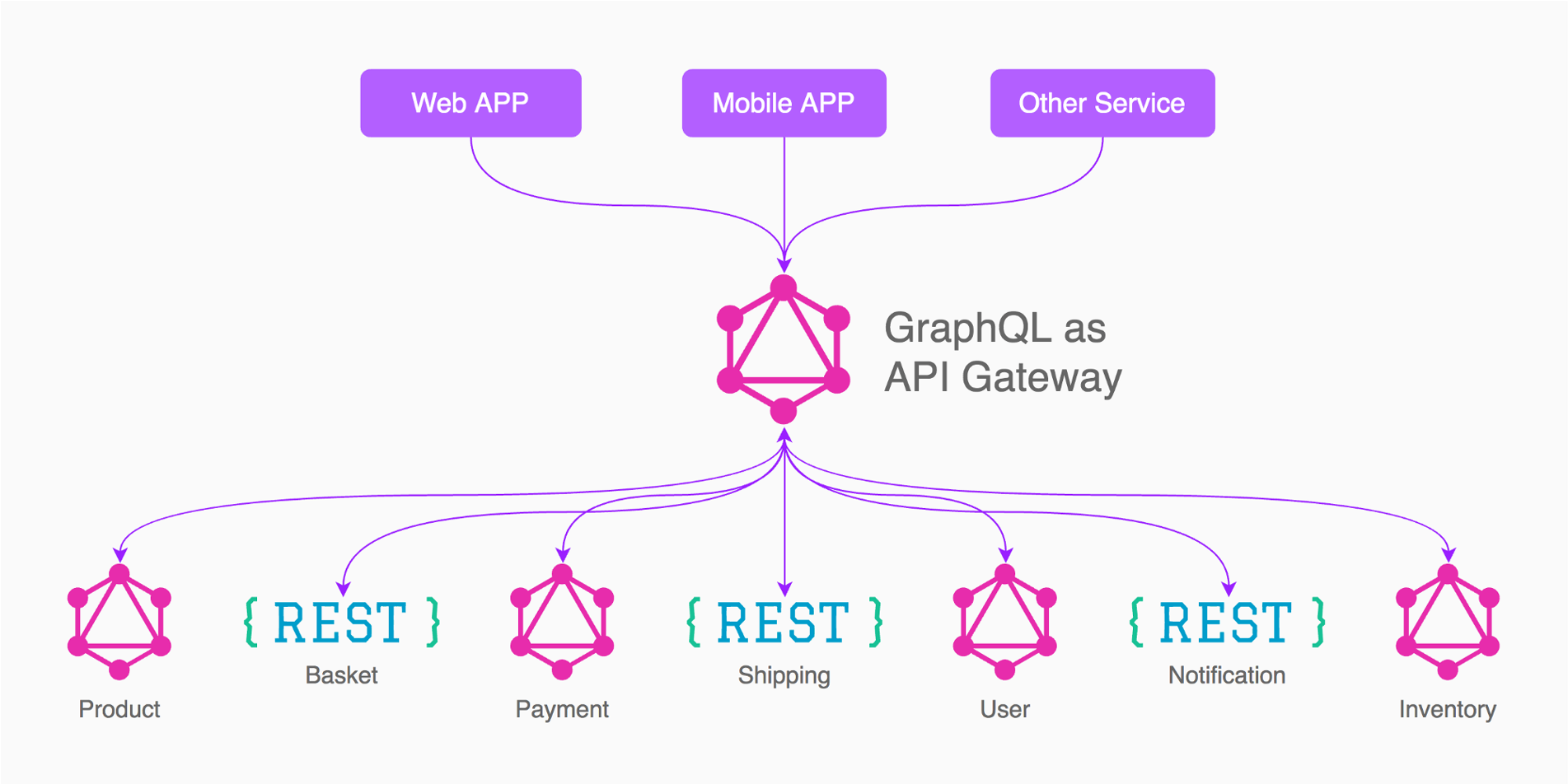
In this model, the architecture employs a single GraphQL schema that functions as an API Gateway. This gateway proxies requests to targeted microservices and coerces their responses into a unified graph. The underlying microservices may still communicate via REST or Thrift protocols but the client sees only one cohesive API.
The Trade-off: The primary downside is coupling. Every time a microservice contract changes its input or output, the API Gateway schema must be updated accordingly to reflect these changes.
🧩 Approach 2: Multiple Schemas per Service
The alternative strategy involves maintaining a separate GraphQL schema for each microservice. A smaller, thinner API Gateway routes requests containing the GraphQL query directly to the targeted service.
The Trade-off: While this strictly enforces schema definitions at the service level, it fragments the client experience. If the client needs data from three different services, they must effectively manage three different API connections.
GraphQL
🏆 Why the Unified Gateway Wins
Despite the maintenance overhead of the first approach, having clients communicate with multiple GraphQL services generally defeats the primary purpose of using GraphQL. The goal of GraphQL is to provide a schema over your entire application data to allow fetching it in a single roundtrip.
From a frontend perspective, the client should not be aware that the backend is split into microservices. A unified GraphQL gateway hides this architectural complexity. It allows you to split your backend into microservices for operational efficiency while still providing a single API to all your applications. This enables powerful features like joins across data from different services which would be impossible with isolated schemas.
If a "shared nothing" architecture is strictly enforced all the way to the client, you create a maintenance nightmare where updating a single backend service requires updating every client application.
🚧 Technical Challenges and Workarounds
While GraphQL offers excellent control over data loading and ownership, there are specific technical constraints you must navigate.
1. Indefinite Query Depth GraphQL cannot query in indefinite depth. If you are modelling a tree structure and want to return a recursive branch without knowing the depth beforehand, you will have to implement pagination or flatten the structure.
2. Network Level Caching Because GraphQL typically operates over HTTP via a single POST endpoint, standard network-level caching is difficult. A common solution is to use Persisted Queries, which allows you to hash queries and cache the results effectively.
3. File Uploads The GraphQL specification does not natively handle file uploads and mutations do not accept files as arguments. Standard workarounds include:
Using a separate REST API for the upload and passing the resulting URL to the GraphQL mutation.
Injecting the file into the execution context so it is available inside the resolver functions.
4. The N+1 Problem The flexibility of GraphQL means execution can be unpredictable. Without careful design, fetching related data (like a list of authors for a list of books) can trigger N+1 database queries. This requires the implementation of Data Loaders to batch and cache requests within a single execution context.
5. Specific Response Structures In GraphQL, the response always matches the shape of the query. If your application requires a very specific JSON structure that differs from your schema graph, you will need to add a transformation layer to reshape the response before it reaches the client.
🛑 When to Avoid GraphQL
GraphQL is a powerful tool for complex systems but it is not a silver bullet. If you are building a service that exposes a very simple API with flat data structures and no need for complex fetching strategies, GraphQL will add unnecessary complexity. In these cases, a simple REST API is often the superior choice.